A living archive of Indigenous history, culture, and contemporary Native voices in music, art, cinema, literature, and current events.
Devoted to all Indigenous nations of the Americas — North, Central, and South.
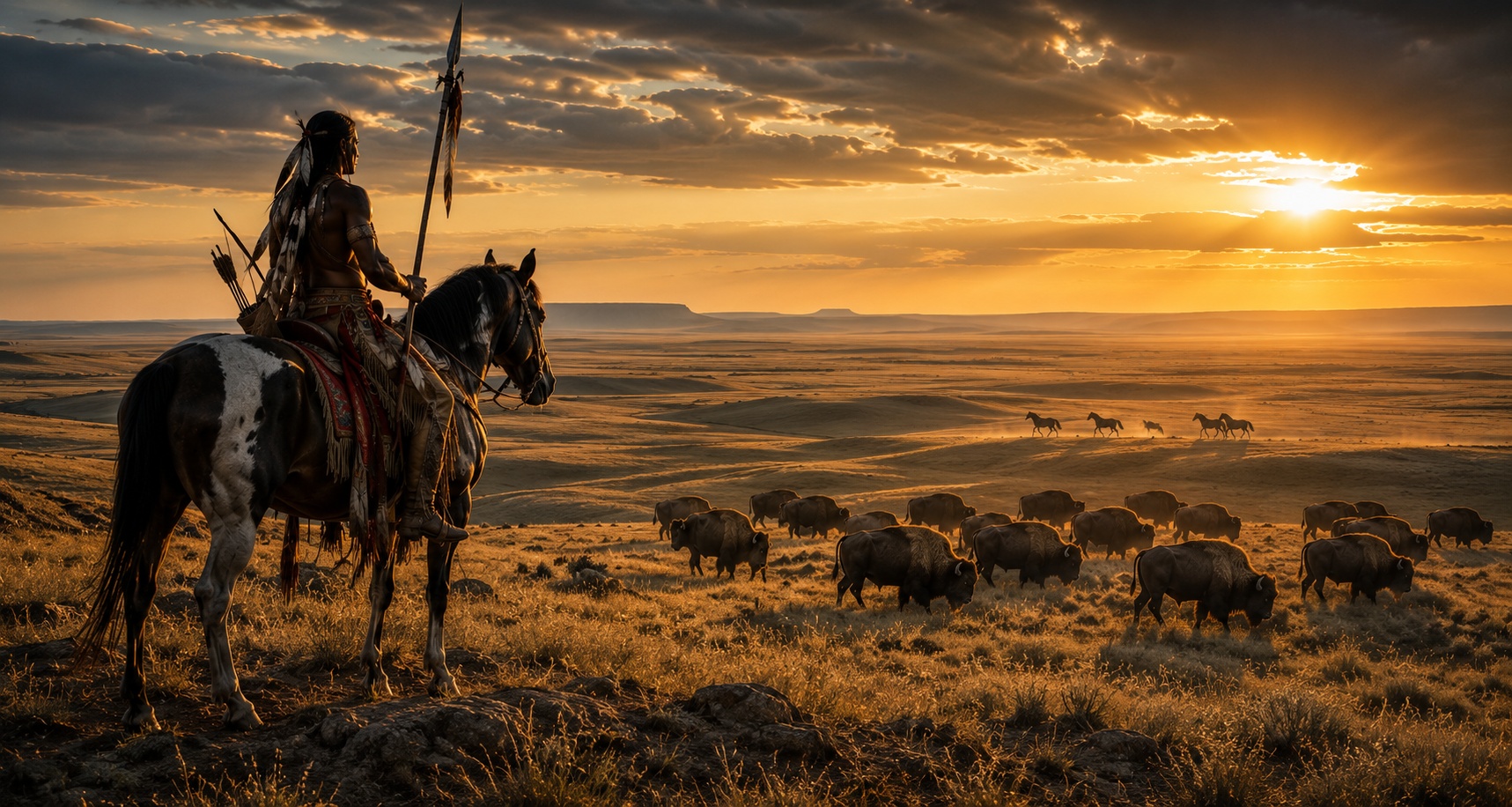
Speeches of the Chiefs
As with all frontier-era oratory, these words passed through interpreters and reporters before reaching print, so surviving versions vary slightly in wording. Scroll to read all three.
1. Ten Bears (Parra-Wa-Samen) — Yamparika Comanche
"My people have never first drawn a bow or fired a gun against the whites. There has been trouble on the line between us, and my young men have danced the war dance. But it was not begun by us. It was you who sent out the first soldier and we who sent out the second. Two years ago I came upon this road, following the buffalo, that my wives and children might have their cheeks plump and their bodies warm. But the soldiers fired on us, and since that time there has been a noise like that of a thunderstorm, and we have not known which way to go.
"Nor have we been made to cry once alone. The blue-dressed soldiers and the Utes came from out of the night when it was dark and still, and for campfires they lit our lodges. Instead of hunting game they killed my braves, and the warriors of the tribe cut short their hair for the dead. So it was in Texas. They made sorrow come in our camps, and we went out like buffalo bulls when their cows are attacked. When we found them we killed them, and their scalps hang in our lodges. The Comanches are not weak and blind, like the pups of a dog when seven sleeps old. They are strong and farsighted, like grown horses.
"But there are things which you have said to me which I do not like. They are not sweet like sugar, but bitter like gourds. You said that you wanted to put us upon a reservation, to build us houses and make us medicine lodges. I do not want them. I was born upon the prairie, where the wind blew free and there was nothing to break the light of the sun. I was born where there were no enclosures and where everything drew a free breath. I want to die there and not within walls.
"When I was at Washington the Great White Father told me that all the Comanche land was ours, and that no one should hinder us in living upon it. So, why do you ask us to leave the rivers, and the sun, and the wind, and live in houses? Do not ask us to give up the buffalo for the sheep. The young men have heard talk of this, and it has made them sad and angry. Do not speak of it more.
"If the Texans had kept out of my country, there might have been peace. But that which you now say we must live on is too small. The Texans have taken away the places where the grass grew the thickest and the timber was the best. Had we kept that, we might have done the things you ask. But it is too late. The white man has the country which we loved, and we only wish to wander on the prairie until we die."
2. Satanta (Set-t'ainte, White Bear) — Kiowa
"All the land south of the Arkansas belongs to the Kiowas and Comanches, and I don't want to give away any of it. I love the land and the buffalo, and will not part with it. I want you to understand well what I say. I want you to understand, also, that the Kiowas and Comanches don't want to fight, and have not been fighting since we made the treaty. I hear a good deal of talk from these gentlemen, but they never do what they say. I don't want any of these medicine lodges built in this country. I want the papooses brought up exactly as I am. When I make peace, there is no end of it.
"I have heard that you intend to set apart a reservation near the mountains. I don't want to settle. I love to roam over the prairie; there I feel free and happy, but when we settle down we grow pale and die. I have told you the truth. I have no little lies about me; but I don't know how it is with the commissioners. Are they as clear as I am?
"A long time ago this land belonged to our fathers; but when I go up to the river I see camps of soldiers on its banks. These soldiers cut down my timber; they kill my buffalo; and when I see that, my heart feels like bursting; I feel sorry."
3. Satank (Sitting Bear) — Kiowa
"It has made me very glad to meet you, who are the commissioners sent by the Great Father to see us. You have heard much talk by our chiefs, and no doubt are tired of it. I have kept back and said nothing — not that I did not consider myself the principal chief of the Kiowa Nation, but others younger than I desired to talk, and I left it to them.
"Before leaving, however, as I now intend to go, I come to say that the Kiowas and Comanches have made with you a peace, and they intend to keep it. If it brings prosperity to us, we of course will like it the better. If it brings poverty and adversity, we will not abandon it. It is our contract, and it shall stand. We do not break treaties. We make but few contracts, and them we remember well. The whites make so many that they are liable to forget them.
"The white man once came to trade; he now comes as a soldier. He once put his trust in our friendship and wanted no shield but our fidelity. But now he builds forts and plants big guns on their walls. He once gave us arms and powder and ball, and bade us hunt the game. We then loved him for his confidence; he now suspects our plighted faith and drives us to be his enemies.
"Look at this medal I wear. By wearing this I have been made poor. Formerly I was rich in horses and lodges; today I am the poorest of all. When you put this silver medal on my neck you made me poor.
"I am old, but still am chief. I shall soon have to go the way of my fathers. But those who come after me will remember this day. It is now treasured up by the old, and will be carried by them to the grave, and then handed down to be kept as a sacred tradition by their children and their children's children. And now the time has come that I must go. Good-bye! You may never see me more, but remember Satank as the white man's friend."
Having finished, the old chief walked down the line of commissioners, shook hands with each, mounted his pony, and rode away.
A note on the sources: these speeches survive because reporters — chiefly Henry M. Stanley, later famous for finding Dr. Livingstone — transcribed the interpreters' renderings at the council. The texts follow versions printed in Stanley's dispatches and reproduced in later works including W. C. Vanderwerth's Indian Oratory (1971), Charles M. Robinson III's Satanta (1997), and Douglas C. Jones's The Treaty of Medicine Lodge (1966). Because everything passed through translation and shorthand, wording differs slightly between reprints; the substance is consistent across sources.
El Requerimiento
Read alongside the chiefs' speeches. One column is a people explaining their land in their own words. The other is an empire explaining, in advance, why taking it would be lawful.
What It Declared
"But if you do not do this … I certify to you that, with the help of God, we shall powerfully enter into your country, and shall make war against you in all ways and manners that we can, and shall subject you to the yoke and obedience of the Church and of their Highnesses; we shall take you and your wives and your children, and shall make slaves of them …
… and we shall take away your goods, and shall do you all the mischief and damage that we can. And we protest that the deaths and losses which shall accrue from this are your fault."
How It Was Used
It was read in Spanish, to people who did not speak Spanish. It was read from the decks of ships anchored offshore. It was read at night, to sleeping villages. It was read to empty forests where no one remained to hear it. The reading was recorded by a notary, and the requirement of law was satisfied.
Even Spaniards of the era treated it with contempt. The royal historian Gonzalo Fernández de Oviedo, who carried the document himself, wrote that he did not know whether to laugh or to weep at it.
The Document Itself
The Legal Architecture Behind It
Those Who Wrote It & Those Who Fought It
Modern Scholarship
Its Living Legacy
Five hundred and ten years separate the Requerimiento from the Vatican's repudiation of the doctrine it served. The land has not been returned.
Indigenous Nations
A living directory of the nations of North America. Select a nation to open its record — history, timeline, sources, and voices — in the format of the Comanche archive.
Gold = record complete · Red = in development
- Apache
- Arapaho
- Blackfeet
- Caddo
- Cherokee
- Cheyenne
- Chickasaw
- Chippewa (Ojibwe)
- Choctaw
- Comanche
- Crow
- Haudenosaunee (Iroquois)
- Hopi
- Kiowa
- Lakota · Dakota · Nakota (Sioux)
- Menominee
- Modoc
- Muscogee (Creek)
- Navajo (Diné)
- Nez Perce
- Osage
- Paiute
- Pawnee
- Pequot
- Ponca
- Potawatomi
- Powhatan
- Pueblo Nations
- Seminole
- Seneca
- Shawnee
- Shoshone
- Tlingit & Haida
- Ute
- Wampanoag
- Yakama
- Zuni
A living list — not yet every nation. Missing one? Tell us to add it.
- Amuzgo
- Chatino
- Chichimeca Jonaz
- Chinantec
- Ch'ol
- Chontal
- Cora (Náayeri)
- Cucapá (Cocopah)
- Huastec (Tének)
- Huichol (Wixárika)
- Kickapoo (Kikapú)
- Kiliwa
- Kumiai (Kumeyaay)
- Lacandon
- Maya (Yucatec)
- Mayo (Yoreme)
- Mazahua
- Mazatec
- Mixe (Ayuujk)
- Mixtec (Ñuu Savi)
- Nahua (Mexica)
- Otomí (Hñähñu)
- Pame
- Pima (O'odham)
- Popoluca
- Purépecha
- Rarámuri (Tarahumara)
- Seri (Comcáac)
- Tepehuán (O'dam)
- Tohono O'odham
- Tojolabal
- Totonac
- Triqui
- Tzeltal
- Tzotzil
- Yaqui (Yoeme)
- Zapotec (Binnizá)
- Zoque
A living list — not yet every nation. Missing one? Tell us to add it.
- Algonquin
- Anishinaabe (Ojibwe)
- Assiniboine (Nakoda)
- Atikamekw
- Beothuk
- Blackfoot Confederacy
- Cree (Nehiyaw)
- Dakota & Nakota
- Dene
- Gitxsan
- Haida
- Haudenosaunee (Six Nations)
- Heiltsuk
- Innu
- Inuit
- Kwakwaka'wakw
- Maliseet (Wolastoqiyik)
- Métis
- Mi'kmaq
- Mohawk (Kanien'kehá:ka)
- Nisga'a
- Nuu-chah-nulth
- Oji-Cree
- Okanagan (Syilx)
- Secwépemc
- Squamish
- Stó:lō
- Tlingit
- Tsilhqot'in
- Tsimshian
- Wendat (Huron)
- Wet'suwet'en
A living list — not yet every nation. Missing one? Tell us to add it.
Nation
The record of this nation.
This nation's timeline is being built — origins, homelands, treaties, resistance, and survival, told in the same format as the Comanche archive.
Have a source, a date, or an oral history that belongs here? Submit it to the archive.
The directory of books, scholarship, archives, audio, music, film, and chiefs for this nation is in development.
Know something that belongs here? Send it in or email never_a_savage@proton.me.
Comanche
The Comanche (Nʉmʉnʉʉ, "the People") built the most powerful Indigenous empire of the southern plains, Comanchería, dominating trade, diplomacy, and war across Texas, New Mexico, and northern Mexico for more than 150 years.
Moving south from the Shoshone homelands, the Comanche master the horse and remake themselves into the finest light cavalry on the continent.
An empire of trade and mobility spreads across the southern plains, holding Spanish, French, and later Mexican and Texan expansion in check.
Raids reach deep into Durango, Chihuahua, and Coahuila, hollowing out northern Mexico on the eve of the U.S.–Mexican War.
Texan treachery at a peace council in San Antonio ignites the Great Raid on Linnville and the Battle of Plum Creek.
Comanche and Kiowa fighters turn back Kit Carson's much larger force in the Texas Panhandle.
After the slaughter of the southern buffalo herds, the Army drives the Comanche from the plains at Palo Duro Canyon. Quanah Parker's band surrenders at Fort Sill in 1875 — the end of Comanchería.
The Comanche Nation endures — some 17,000 enrolled citizens, headquartered at Lawton, Oklahoma, reviving language, art, and sovereignty.
U.S. Cavalry & Rangers
Comanche (Nʉmʉnʉʉ)
For decades the Comanche bow out-shot the frontier's single-shot muzzleloaders — quicker to loose, silent, and lethal from a galloping horse. The balance tipped only when repeating arms arrived: the Colt revolver, then the lever-action rifle, finally let a handful of soldiers put out more fire than a war party of expert archers. That, together with the deliberate slaughter of the buffalo, ended Comanchería — not any failing of the warrior.
Faces of the Nation — every portrait catalogued with the person's name (where known), place, and date. Curated from the great public archives:
The mustang — the hardy, Spanish-descended plains pony. A warrior's wealth was measured in horses, and the best ponies were trained to specialize: a swift "buffalo runner" for the hunt, a steady war pony for battle, a racer for sport. A single gifted horse might do all three.
For war and the hunt, usually not. Warriors rode bareback or on a light hide pad, steering with knee pressure and a single rawhide rein looped around the horse's lower jaw — leaving both hands free for bow or lance. Framed saddles were used mainly for travel and by women.
Almost before they could walk. Children were placed on a pony and led around by about age three; by four or five they rode alone. Boys were given their own horse young and drilled with it every single day.
Training built from picking small objects off the ground at a gallop, working up to lifting a fallen comrade at full speed. Their signature feat — witnessed by the artist George Catlin — was to drop down the side of a galloping horse, a heel hooked over its back and a loop braided into the mane, and loose arrows from beneath the horse's neck, using the animal itself as a moving shield. Controlling the horse with their knees, they could pour out arrows faster than a soldier could reload.
Sources: Smithsonian — Comanche Feats of Horsemanship (George Catlin); Wallace & Hoebel, The Comanches: Lords of the South Plains.
A living directory of all things Comanche: chiefs, books, scholarship, archives, audio, music, and film. Have something to add? Send it in.
Chiefs of the Bands
Band affiliations were fluid, and leaders moved between divisions; attributions follow the most-cited sources.
Books
- Empire of the Summer Moon
- The Comanche Empire
- Comanches: The History of a People
- The Comanches: Lords of the South Plains
- Quanah Parker, Comanche Chief
Articles & Scholarship
Archives & Websites
- Comanche Nation (Official)
- Comanche National Museum & Cultural Center
- Comanche THPO
- Texas Beyond History (UT Austin)
Podcasts & Audio
Music
Film & Video
This directory is actively growing. Know a book, paper, site, podcast, song, or film that belongs here? Submit it to the archive or email never_a_savage@proton.me.
Ute
The Ute (Núuchiu, "the People") are the oldest continuous residents of Colorado and Utah — the state of Utah bears their name. Masters of the horse and guardians of the Shining Mountains, they held the central Rockies and the Great Basin's eastern edge for centuries.
The Núuchiu homeland spans the mountains and plateaus of present-day Colorado and Utah, into New Mexico and Wyoming — one of the longest continuous homelands in North America.
The Ute are among the very first Native peoples to adopt the Spanish horse — transforming their world generations before most Plains nations.
After the Pueblo Revolt scatters Spanish herds, the Ute become key traders of horses to the Shoshone, Plateau, and Plains peoples — reshaping the West.
The Spanish expedition crosses deep into Ute country, mapping a people already mounted, mobile, and powerful.
The Treaty of Abiquiú marks the first formal treaty between the Ute and the United States.
Chief Wakara (Walkara) leads resistance against Mormon expansion into Ute lands in Utah.
Antonga Black Hawk leads the longest and costliest conflict in Utah's territorial history.
With Ouray as principal chief, a reservation of roughly 16.5 million acres — the western third of Colorado — is guaranteed to the Ute.
The San Juan mining country — some four million acres — is stripped away as gold and silver draw in prospectors.
The White River War — the last major armed conflict in Colorado. Agent Nathan Meeker's push to force farming on the Ute ends in the Battle of Milk Creek.
Colorado's rallying cry. The Northern bands are removed from their homeland to the Uintah Reservation in Utah.
The Ute endure as three sovereign nations — Ute Indian Tribe (Uintah & Ouray, Utah), Southern Ute, and Ute Mountain Ute (Colorado) — keeping the Bear Dance, the language, and the land.
The Homeland — before 1868
Today
The Treaty of 1868 cut the Ute homeland from roughly 56 million acres to about 16.5 million. The Brunot Agreement (1873) took the San Juan mining country, and after the events of 1879 the Northern bands were removed to Utah. What remains are three sovereign Ute nations — diminished in land, unbroken as peoples.
Faces of the Núuchiu — portraits catalogued with names, places, and dates, from the great public archives:
The Ute were among the earliest Native peoples in North America to adopt the horse — by about 1637, generations before the horse reached most of the Plains. It remade their range, their hunting, and their power.
The Ute became the great horse traders of the interior West, carrying horses north and east to the Shoshone, the Plateau, and eventually the Plains nations — the Ute were a gateway through which the horse transformed a continent.
Unlike the open-plains riders, the Ute mastered horseback travel and hunting across high, broken mountain country — then rode out onto the plains for buffalo, and back into the peaks that sheltered them.
Sources: NPS — Ute & the Old Spanish Trail; Simmons, The Ute Indians of Utah, Colorado, and New Mexico.
A living directory of all things Ute: chiefs, books, scholarship, archives, audio, music, and film. Have something to add? Send it in.
Chiefs of the Bands
Band affiliations were fluid, and leaders moved between divisions; attributions follow the most-cited sources.
Books
- The Ute Indians of Utah, Colorado, and New Mexico
- People of the Shining Mountains
- The Last War Trail
- Ute Indian Arts & Culture
- Ouray: Chief of the Utes
Articles & Scholarship
- Colorado Encyclopedia — Ute History
- Colorado Encyclopedia — Ute Treaty of 1868
- Treaty with the Ute, 1868 — full text
- The Ute Campaign of 1879 (PDF)
- Utah History — Ute Indians
Archives & Websites
- Southern Ute Indian Tribe (Official)
- Ute Mountain Ute Tribe (Official)
- Ute Indian Tribe — Uintah & Ouray (Official)
- Ute Indian Museum — History Colorado
Podcasts & Audio
Music & Ceremony
Film & Video
This directory is actively growing. Know a book, paper, site, podcast, song, or film that belongs here? Submit it to the archive or email never_a_savage@proton.me.
Apache Wars
Apache (Nde) bands — Chiricahua, Mescalero, Jicarilla, and Western Apache — resisted Spain, then Mexico, then the United States across the Southwest borderlands for nearly three centuries.
Spanish–Apache Frontier War
Generations of raiding and reprisal across Nueva Vizcaya until the Spanish "establecimientos de paz" of 1786 buy an uneasy truce.
Apache–Mexico Wars
Chihuahua and Sonora post cash bounties for Apache scalps; Apache bands answer with a half-century of borderland war that spills across the international line.
Cochise & the Bascom Affair
A false accusation and a hanging ignite eleven years of Chiricahua war under Cochise across southern Arizona.
Victorio's War
Victorio leads Chihenne and Mescalero fighters against two armies across New Mexico, Texas, and Chihuahua until his death at Tres Castillos.
Geronimo & the Last Holdouts
Geronimo's Chiricahua band conducts the final Apache resistance. His 1886 surrender ends the American Indian Wars; the Chiricahua are shipped east as prisoners of war for 27 years.
Yaqui
The Yaqui (Yoeme, "the People"; Hiaki) of the Río Yaqui valley in Sonora waged the longest sustained Indigenous resistance in the Americas — from the first Spanish expedition in 1533 to the final uprising of 1929. Spain never conquered them. Mexico never broke them.
Yaqui warriors turn back Diego de Guzmán's expedition at the Río Yaqui — the first of many Spanish forces to be defeated on Yaqui ground.
After defeating Spanish forces under Hurdaide three times, the Yaqui negotiate peace themselves. They are never conquered militarily by Spain.
Jesuits enter by invitation, not conquest. The people consolidate into the eight pueblos that still define the nation: Cócorit, Bácum, Tórim, Vícam, Pótam, Ráhum, Huírivis, and Belem.
A joint rising against colonial labor and land demands shakes Spanish Sonora.
After Mexican independence, Banderas seeks to unite the Indigenous peoples of Sonora into a confederation against the new state.
José María Leyva builds a functioning autonomous Yaqui nation — government, army, courts, and taxation. Defeated at Buatachive in 1886; executed in 1887.
Juan Maldonado leads fourteen years of guerrilla war from the Bacatete Mountains until his betrayal and death on 9 July 1901.
Hundreds of Yaqui are killed in the Bacatete range — one of the darkest days of the long war.
Between 8,000 and 15,000 Yaqui — from a population of roughly 30,000 — are deported to the henequen plantations of Yucatán and the cane fields of Oaxaca. Families were broken apart and worked to death. Many historians name it genocide.
Yaqui fighters take part in the Mexican Revolution, trading their arms for the promise of their land returned.
The final armed Yaqui rebellion against the Mexican army — nearly four hundred years after the first.
President Lázaro Cárdenas formally recognizes a Yaqui territory in Sonora, restoring part of the homeland and rights to the river.
Yaqui families who fled the deportations north gain U.S. federal recognition as the Pascua Yaqui Tribe near Tucson, Arizona.
Mexico issues a formal apology for the crimes committed against the Yaqui and announces a justice plan. The struggle over the Río Yaqui's water continues.
Spain — 1533–1821
Mexico — 1821–1929
From the first Spanish expedition in 1533 to the last uprising in 1929 — 396 years of continuous armed defense of the Río Yaqui. No other Indigenous nation in the Americas resisted for so long, against two empires in succession, and remained on its own river.
Faces of the Yoeme — images catalogued with names, places, and dates where known:
Yoeme means "the people." Yaqui and Hiaki come from the river that has defined the nation for as long as it has existed — the Yaqui are, first and last, a people of the Río Yaqui.
Cócorit, Bácum, Tórim, Vícam, Pótam, Ráhum, Huírivis, and Belem — the eight towns that have organized Yaqui governance and ceremony for four centuries. Vícam serves as the traditional seat.
The Maaso (deer dancer) and the deer songs — maso bwikam — are among the oldest continuously performed traditions in the Americas, carried through the Waehma ceremonial cycle each spring. The deer dancer is the emblem of Sonora itself.
The eight pueblos in Sonora, Mexico, and the Pascua Yaqui Tribe near Tucson, Arizona — the only federally recognized Yaqui tribe in the United States, formed by families who fled the deportations. One nation, divided by a border.
Yoem noki — the Yaqui language, a Uto-Aztecan tongue — is still spoken on both sides of the border, and actively taught.
Sources: Edward H. Spicer, The Yaquis: A Cultural History; Evelyn Hu-DeHart, Yaqui Resistance and Survival; Evers & Molina, Yaqui Deer Songs.
A living directory of all things Yaqui: leaders, pueblos, books, scholarship, archives, audio, music, and film. Have something to add? Send it in.
Leaders of the Resistance
The Eight Sacred Pueblos
Books
- The Yaquis: A Cultural History
- Yaqui Resistance and Survival
- Yaqui Deer Songs / Maso Bwikam
- Missionaries, Miners & Indians
Articles & Scholarship
- Yaqui scholarship on JSTOR
- The deportations — scholarship
- Yaqui — Encyclopedia.com
- The Enduring Legacy of the Yaquis
Archives & Websites
Podcasts & Audio
Music & Ceremony
Film & Video
This directory is actively growing. Know a book, paper, site, podcast, song, or film that belongs here? Submit it to the archive or email never_a_savage@proton.me.
Sioux Wars
The Očhéthi Šakówiŋ — the Seven Council Fires of the Dakota, Lakota, and Nakota — defended the northern plains and the sacred Black Hills (Ȟe Sápa) against the United States.
The U.S.–Dakota War
Starved by late annuities and broken treaties, Dakota fighters rise in Minnesota. The aftermath brings the largest mass execution in U.S. history — 38 Dakota hanged at Mankato.
Red Cloud's War
Lakota, Cheyenne, and Arapaho close the Bozeman Trail and win — the United States abandons its forts and signs the Fort Laramie Treaty of 1868, guaranteeing the Black Hills "in perpetuity."
The Great Sioux War — Little Bighorn
After gold is found in the treaty-guaranteed Black Hills, Lakota and Cheyenne under Sitting Bull and Crazy Horse destroy Custer's command at the Greasy Grass.
Wounded Knee
Amid the Ghost Dance movement, the 7th Cavalry kills nearly 300 Lakota men, women, and children at Wounded Knee Creek. Twenty Medals of Honor are awarded; the fight to rescind them continues today.
Before It Was Called America
Two continents were named for Amerigo Vespucci — a Florentine navigator who never set foot on North America — by Martin Waldseemüller, a German mapmaker who never crossed the Atlantic at all. They already had names — hundreds of them, in hundreds of languages, given by the people who lived here.
Turtle Island
In the creation traditions of many nations of the northeast and Great Lakes, the world begins with water. Sky Woman falls from the world above, and the animals dive to the bottom of the sea for earth. One after another they fail — until the muskrat surfaces with a handful of mud, and it is spread on the back of a great turtle. The land grows from there.
This is not a metaphor for North America. In these traditions it is North America — a living being who carries the people on her back.
Today "Turtle Island" is used across Native North America as the continent's Indigenous name, in land acknowledgments, in literature, and in everyday speech.
Abya Yala
In the language of the Guna people, Abya Yala means "land in full maturity" or "land of vital blood." It is the Guna name for the continent — and since the 1970s it has been adopted across Indigenous movements throughout Central and South America as a deliberate alternative to "America."
The Aymara leader Takir Mamani argued that to keep calling the continent by a colonizer's name was to accept the conquest in language. Naming it Abya Yala was a way of refusing that.
America is named for Amerigo Vespucci. Abya Yala is named by the people who were already here.
Click any gold marker on the map — or a name below — to see that nation's own name for its homeland, the language it comes from, and what it means.
Marker positions are approximate and indicate a homeland region, not a border. Many nations held — and hold — territory far larger than a single point can show, and spellings vary between orthographies and dialects.
Names That Were Replaced
| Colonial name | Indigenous name | Language & meaning |
|---|---|---|
| Mount McKinley | Denali | Koyukon Athabascan — "the high one."Officially restored as Denali in 2015; federally reverted to McKinley in 2025. Alaska's senators and a majority of Alaskans opposed the reversal; the state continues to use Denali. |
| Black Hills | Ȟe Sápa | Lak˙hótiyapi — "black mountains," the heart of everything that is.Guaranteed by treaty in 1868, seized after gold was found in 1874. |
| Devils Tower | Maťhó Thípila | Lak˙hótiyapi — "Bear Lodge."The colonial name is widely believed to have come from a mistranslation. Tribes have petitioned for restoration for decades. |
| Mount Rainier | Taqʷuʲmaʲ / Tahoma | Lushootseed — "the mountain."Renamed for a British admiral who never saw it. |
| Yosemite Valley | Ahwahnee | Miwok — "gaping mouth.""Yosemite" derives from a Miwok word for the people who fought the militia that took the valley. |
| Colorado | Núuchiu country | Spanish "colored red" — against the Ute homeland of the Shining Mountains.The Colorado River is Pisisvayu to the Hopi. |
Names That Survived — Altered
| Name on the map | From | Language & meaning |
|---|---|---|
| Canada | Kanata | St. Lawrence Iroquoian — "village, settlement."Cartier mistook a word for a town as the name of a country. |
| Mexico | Mēxihco | Nahuatl — the Mexica heartland in the Valley of Anáhuac. |
| Mississippi | Misi-ziibi | Anishinaabemowin — "great river." |
| Chicago | Shikaakwa | Myaamiaataweenki — "place of the wild leek." |
| Texas | Táyshaʔ | Caddo — "friends" or "allies." |
| Massachusetts | Massachusett | Massachusett — "at the great hill." |
| Utah | Ute | From the Núuchiu — a state named for a people it then removed. |
| Nunavut | Nunavut | Inuktitut — "our land."Not a survival but a restoration: the territory was created and named in 1999. |
Broken Promises
The United States ratified more than 370 treaties with Native nations — nation to nation — and broke essentially every one. This is the ledger of what was promised and what happened after.
Fort Laramie Treaties
The Black Hills and the Great Sioux Reservation are guaranteed to the Lakota "for as long as the grass shall grow." Gold is found in 1874; the U.S. seizes the Hills in 1877. In United States v. Sioux Nation (1980) the Supreme Court rules the taking illegal and awards compensation — the Lakota refuse the money and demand the land. The fund now exceeds a billion dollars, untouched.
Treaty of New Echota
Signed by a small unauthorized faction, rejected by the Cherokee Nation and most of its people — yet enforced by the U.S. as the legal basis for the Trail of Tears.
Medicine Lodge Treaty
Promises schools, goods, and a southern-plains homeland to the Comanche, Kiowa, and Apache — obligations broken within years, culminating in the Red River War.
The Full Treaty Record
This ledger is expanding — treaty by treaty
The Buffalo
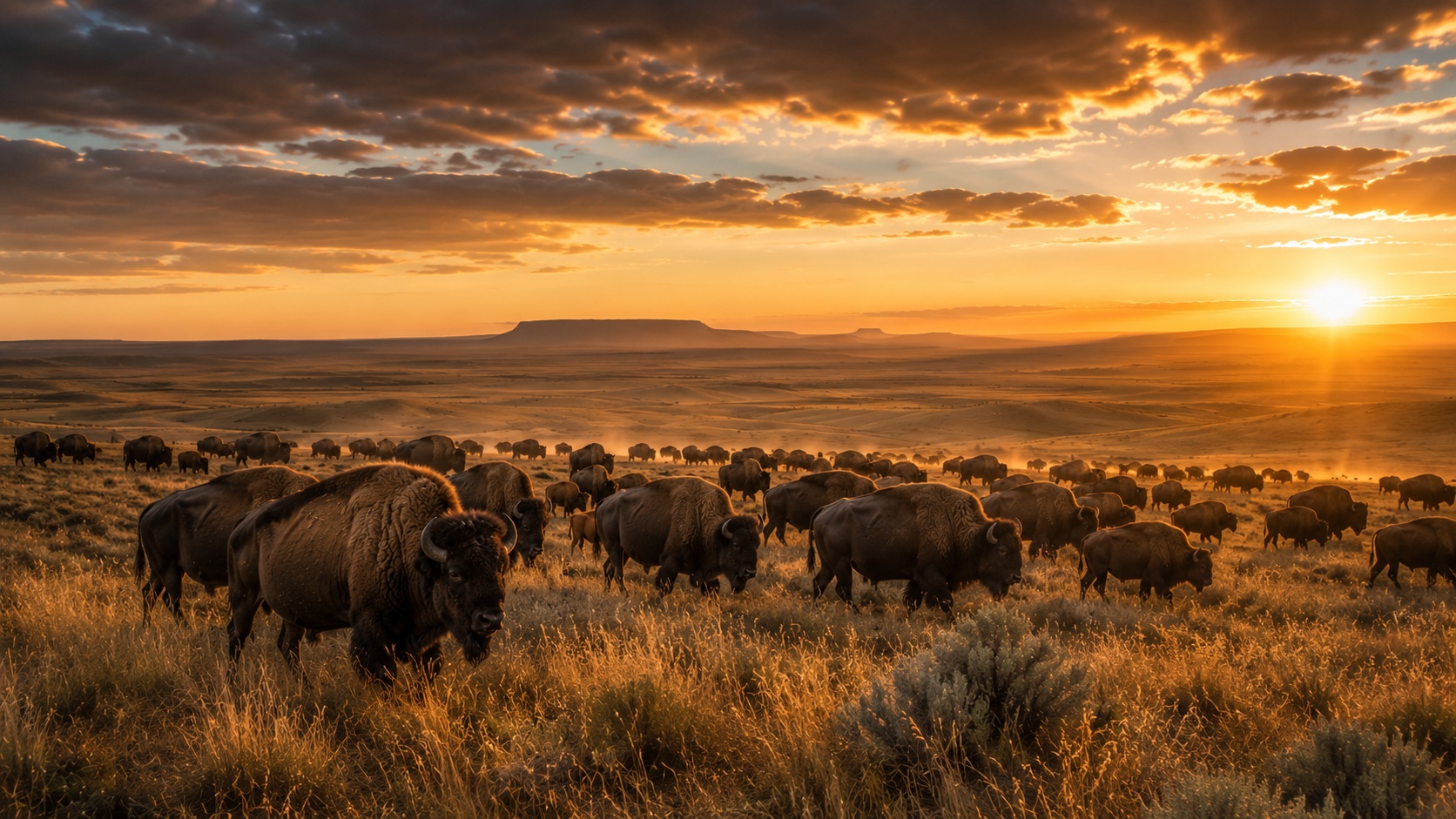
Tatanka (Lakota) · Kutsu (Comanche) · Bishishjik (Apache) · Kuchu (Ute). The American bison was the life of the Plains — food, shelter, clothing, tools, and ceremony. To destroy the buffalo was to wage war on a people. This is the record, kept in their honor.
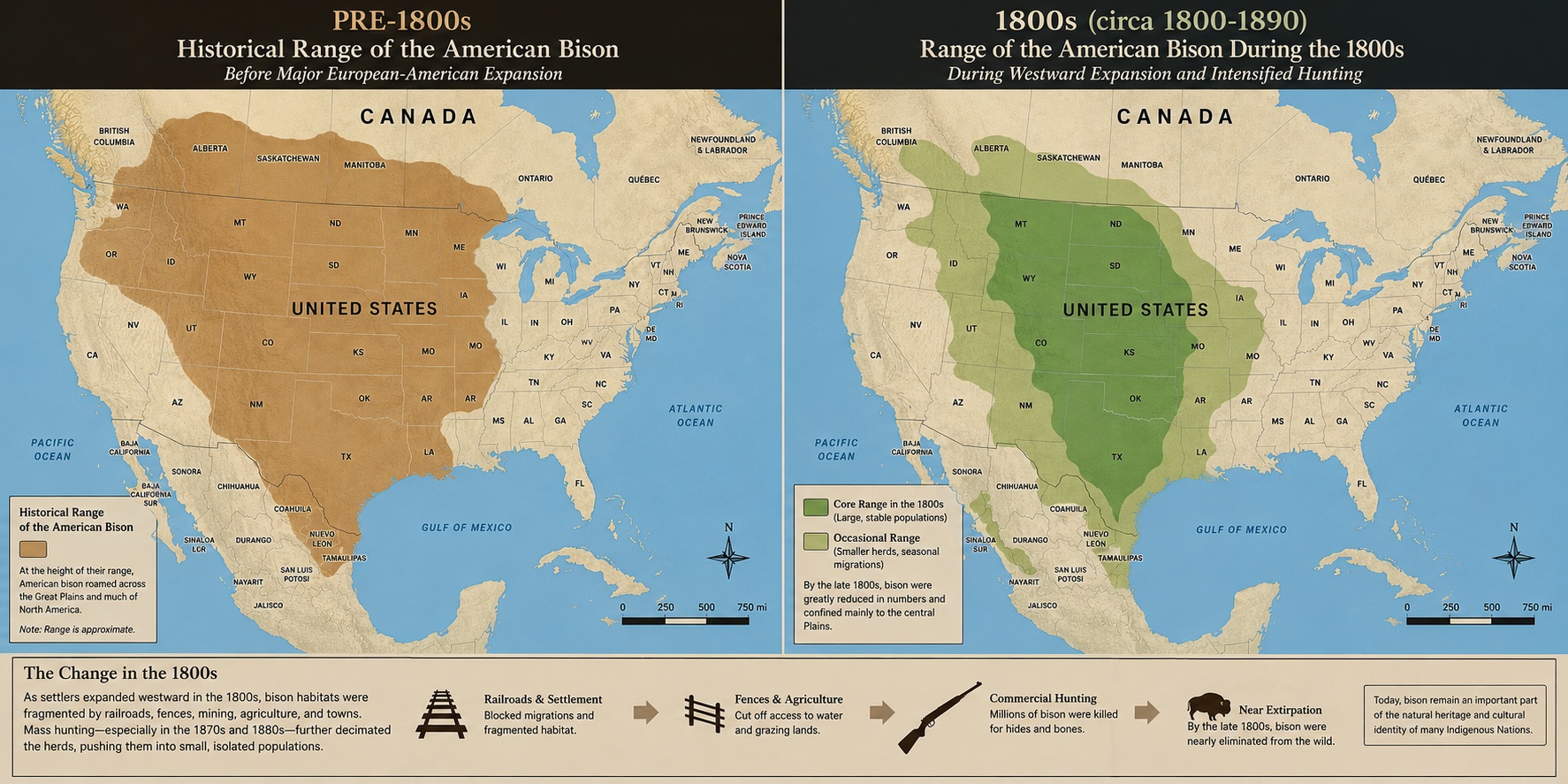
At their height, bison ranged from the Great Slave Lake in northern Canada south into Chihuahua and Durango, Mexico, and from the Rocky Mountains east once as far as the Appalachians. The transcontinental railroad (1869) split them into a northern and a southern herd, and the herds were destroyed one after the other — until, by the late 1880s, the buffalo were nearly gone from the wild. Click the map to view full size.
Bars shown on a logarithmic scale — the true drop is so steep it cannot be drawn to linear scale. Figures: U.S. National Park Service; W.T. Hornaday, The Extermination of the American Bison (1889).
The near-extinction of the buffalo was not an accident of nature. It was driven by people, markets, and policy, all at once.
The Machinery of Killing
- The railroads. The transcontinental line (1869) carried hunters and hides in and out, and split the herd in two. Passengers shot buffalo from train windows for sport, leaving them where they fell.
- The tanneries. Around 1871, new industrial tanning processes made buffalo hide valuable as commercial leather. A market exploded overnight.
- The hide hunters. Armed with long-range Sharps rifles, professional hunters killed on an industrial scale — thousands per day at the peak. The southern herd was effectively gone by the late 1870s; the northern herd by 1883.
- The bone trade. What was left — the bones — was gathered by the ton and shipped east to be ground into fertilizer and bone char.
The Policy Behind It
The U.S. government understood exactly what the buffalo meant to the Plains nations, and the military encouraged the herds' destruction as a way to force those nations onto reservations. In the words of the National Park Service, among the drivers was "the military's directive to destroy buffalo as a way to control American Indians." Commanders and officials of the era spoke openly of ending the herds to break Native resistance — to destroy, in effect, the Plains peoples' commissary. When Texas considered a law to protect the buffalo, senior Army leadership is recorded as opposing it, arguing the hunters should be left to finish their work.
To end the buffalo was a deliberate act of war against a way of life. That is why this page exists.
A handful of private citizens and Native families, beginning in the late 1860s, quietly sheltered the last animals — and nearly every bison alive today descends from those few. The Lacey Act (1894) finally gave Yellowstone's herd legal protection; the American Bison Society (1905) rebuilt public herds; in 2016 the bison was named the national mammal of the United States.
Today more than 60 Native nations are bringing the buffalo home — to their lands, their diets, and their ceremonies. The herds that once darkened the plains are not what they were. But the buffalo is not gone. Tatanka endures.
Gold & Silver
The invasion of the Americas was, in large part, a mining operation. What follows is the accounting — how much was taken, by whom, and what it cost the people who lived on top of it.
Figures are converted at July 2026 spot prices (gold ~$4,017/oz; silver ~$56.63/oz) using 1 tonne = 2,204.62 lbs = 32,150.7 troy oz. These are present metal-value equivalents — not inflation-adjusted historical value, and not a measure of the wealth these metals generated once compounded through European economies for four centuries. Tonnage estimates vary between historians; the most commonly cited ranges are used and rounded down. Contraband and unregistered output are excluded, which means every number here is a floor, not a ceiling.
No great mines — so they took it at sea
France — a different extraction
Britain, France, and the Netherlands ran no Potosí. Their share of American precious metal came largely by capture, trade, and — later, on the North American continent — by taking the ground itself.
Spain's mita conscripted Indigenous men from across the Andes to dig the Cerro Rico, where mercury amalgamation poisoned those the tunnels did not kill. Death-toll estimates range enormously — from tens of thousands to as many as eight million over three centuries — and the highest figures are disputed by historians. What is not disputed: the labor was forced, and it was fatal.
Gold was found on Cherokee land in north Georgia. Within a year Georgia had seized Cherokee territory by law; within a decade the Cherokee were marched west. The Supreme Court ruled for the Cherokee in Worcester v. Georgia — and was ignored.
The Gold Rush brought some 300,000 people onto Native California. The Native population fell from roughly 150,000 to fewer than 30,000 in about twenty-five years, through massacre, starvation, disease, and state-funded militia campaigns — documented by historian Benjamin Madley as genocide.
Custer's expedition confirmed gold in the He Sapa — land guaranteed to the Lakota by treaty six years earlier. The rush that followed brought the Great Sioux War. In United States v. Sioux Nation (1980) the Supreme Court ruled the taking unlawful; the Lakota have refused the money and continue to demand the land.
Sources: Kris Lane, Potosí; Benjamin Madley, An American Genocide; Jeffrey Ostler, The Lakotas and the Black Hills; Earl J. Hamilton, American Treasure and the Price Revolution in Spain.
Every book, documentary, film, and program that ties the mining of precious metals to the taking of Native land. Know one that belongs here? Send it in.
Books — The Americas & Extraction
- Open Veins of Latin America
- Potosí: The Silver City That Changed the World
- Miners of the Red Mountain
- The Other Slavery
- 1493
Books — The Gold Rushes & Native Nations
- An American Genocide
- The Lakotas and the Black Hills
- Black Hills / White Justice
- The Georgia Gold Rush & Cherokee Removal
Film & Documentary
- Even the Rain (También la lluvia)
- The Devil's Miner
- American Experience: The Gold Rush
- The Mission
- The Black Hills & Homestake — documentary
Podcasts & Audio
- BBC In Our Time — history archive
- NPR Throughline
- Search: Potosí & colonial silver
- Search: Gold Rush & Native California
Data & Primary Records
- Gold & silver shipped from the Americas, 1500–1800
- Hamilton, American Treasure and the Price Revolution
- Colonial Silver Mining: Mexico and Peru
- United States v. Sioux Nation (1980)
- Mining & Indigenous labor on JSTOR
This directory is actively growing. Know a book, paper, film, or podcast that belongs here? Submit it to the archive or email never_a_savage@proton.me.
Food of the Americas
A majority of the crops the world eats today were first domesticated by the Indigenous peoples of the Americas. The global table is, quietly, a Native inheritance.
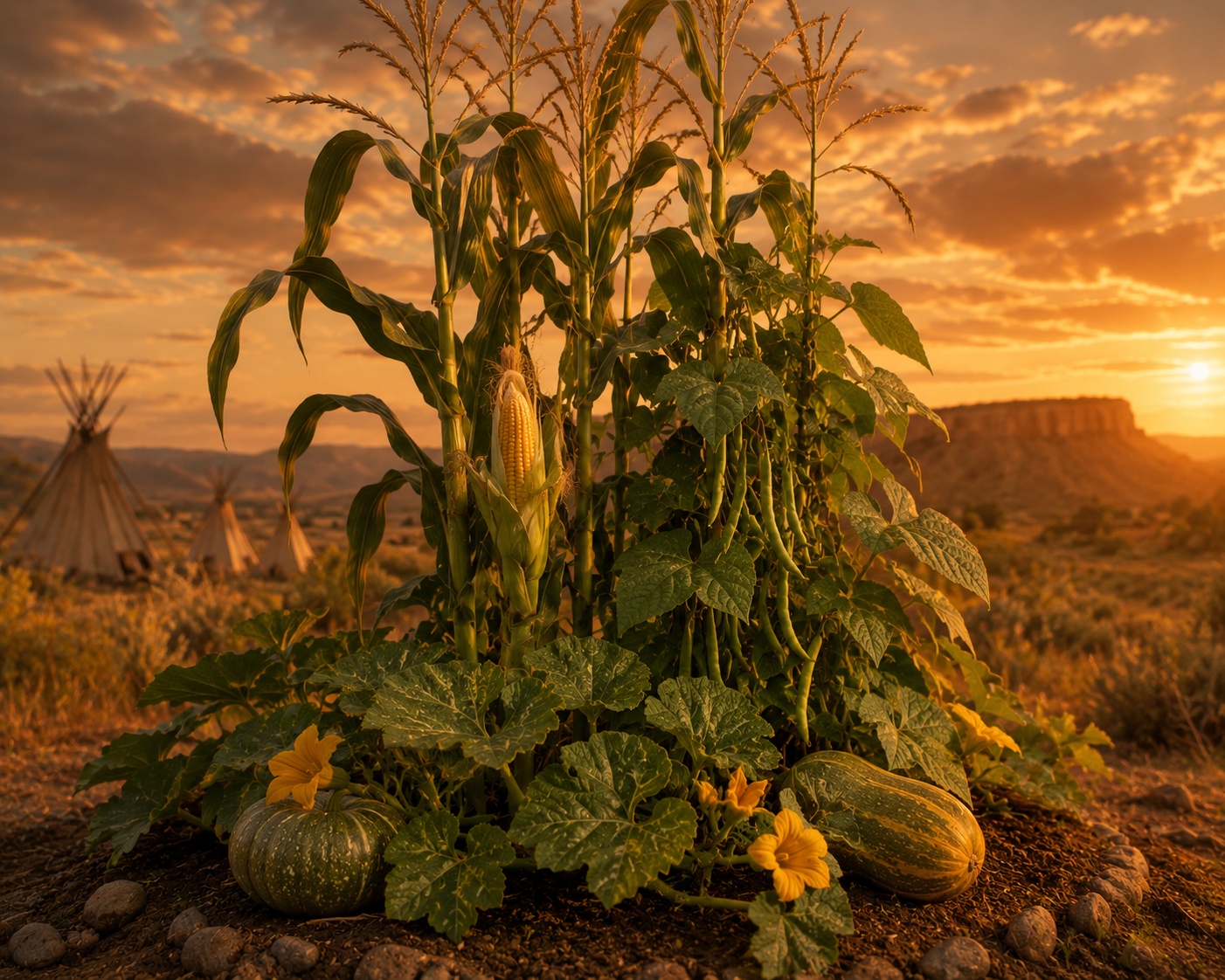
The Three Sisters
Corn, beans, and squash — planted together in a single mound, not in separate rows. It is one of the most elegant agricultural systems ever devised, and it was engineered here.
- Corn grows tall first, becoming the living pole the beans climb.
- Beans climb the cornstalk and fix nitrogen in the soil, feeding all three.
- Squash spreads broad leaves across the ground, shading out weeds and holding moisture in the earth.
Together they also feed a person completely — corn and beans supply complementary amino acids that neither provides alone, and squash adds the oils and vitamins. Maize itself was domesticated from teosinte in Mesoamerica over thousands of years, and became one of the most important staple crops on Earth.
Gifts to the World
- Potato and tomato — Andean and Mesoamerican crops that reshaped the diets of Europe, Africa, and Asia.
- Chili peppers, cacao (chocolate), and vanilla — flavors the world now takes for granted.
- Quinoa, amaranth, and sunflower — nutrient-dense grains and seeds cultivated for millennia.
- Squashes, pumpkins, avocado, pineapple, peanuts, and beans in staggering variety.
These were not wild-gathered accidents. They are the product of thousands of years of Indigenous plant science — selective breeding, seed-keeping, and agricultural knowledge.
This section is growing — crop by crop, nation by nation
Medicine
Indigenous peoples of the Americas developed sophisticated pharmacology, surgery, and healing traditions — many of which underpin modern medicine.
Medicines the World Adopted
- Willow and other bark rich in salicin — the chemical ancestor of aspirin.
- Cinchona bark from the Andes — the source of quinine, the first effective treatment for malaria.
- Ipecac, used against dysentery; coca, a surgical anesthetic precursor; and a vast herbal pharmacopeia.
Knowledge Systems
Beyond individual remedies, Native medicine integrated botany, ceremony, and community care — traditions carried through oral knowledge and still practiced today.
Note: this section documents history and traditional knowledge. It is not medical advice.
This section is growing — plant by plant, tradition by tradition
Music
From the first Native opera in 1913 and the earliest wax-cylinder recordings to this year's Juno and Polaris winners — Native music by era and by genre, every entry linked.
Foundations — 1900 to 1970
- 1913Zitkála-Šá
- 1930sMildred Bailey
- 1958Link Wray
- 1960sPeter La Farge
- 1960sBuffy Sainte-Marie
- 1970sRedbone
- 1970sJesse Ed Davis
- 1971Jim Pepper
- 1972XIT
- Floyd Red Crow Westerman
- The Densmore Recordings (1907–1940s)
Traditional & Flute
Rock, Folk, Country & Blues
- Robbie Robertson
- Rita Coolidge
- Keith Secola
- Bill Miller
- Pura Fé
- Martha Redbone
- Blackfire / Sihasin
- Samantha Crain
- Black Belt Eagle Scout
- William Prince
- Raye Zaragoza
Hip-Hop & Electronic
- NOWStella Standingbear
- The Halluci Nation (A Tribe Called Red)
- Snotty Nose Rez Kids
- Frank Waln
- Supaman
- Litefoot
- DJ Shub
- iskwē
Classical, Opera & Throat Singing
Breaking Now — 2024 to 2026
- 2026Aysanabee
- NOWSiibii
- NOWBrettyn Rose
- NOWSunsetto · Lov · Cat Clyde
- Earth Surface People · Sage Cornelius
Abya Yala — Mexico, Central & South America
- Lila Downs
- Sara Curruchich
- Renata Flores
- Andean & Amazonian recordings
- Yaqui deer songs (maso bwikam)
Awards, Charts & Where to Listen
This library is actively growing and deliberately incomplete — no list of a hemisphere's artists ever finishes. Missing someone? Send them in and they go on the wall. Where an artist's Indigenous ancestry has been publicly disputed, that is noted plainly rather than quietly omitted.
Film & Television
Native cinema from Smoke Signals to Sundance 2025, the documentaries that carry the record, and the series that finally put Indigenous writers in the room.
Our standard: Native content from Native people. Films about us made by outsiders are covered well enough elsewhere — this shelf is for work where Native people held the camera, the pen, or both.
Cinema — The Essentials
- 1998Smoke Signals
- 2001Atanarjuat: The Fast Runner
- 2009Reel Injun
- 2013Rhymes for Young Ghouls
- 2019Blood Quantum
- 2021Night Raiders
- 2022Prey
- 2023Killers of the Flower Moon
- 2023Fancy Dance
- 1989Powwow Highway
- 2015Ixcanul
Documentary
Television & Streaming
This library is actively growing and deliberately incomplete — no list of a hemisphere's artists ever finishes. Missing someone? Send them in and they go on the wall. Where an artist's Indigenous ancestry has been publicly disputed, that is noted plainly rather than quietly omitted.
Art
The potters and painters who changed what Native art was allowed to be — and the artists carrying it into the Whitney, the Met and the Venice Biennale right now.
Art — The Modern Masters
Art — Working Now
This library is actively growing and deliberately incomplete — no list of a hemisphere's artists ever finishes. Missing someone? Send them in and they go on the wall. Where an artist's Indigenous ancestry has been publicly disputed, that is noted plainly rather than quietly omitted.
Literature
Two centuries of Native writing — from the first autobiography published by a Native author in 1829 to this year's Pulitzers and National Book Awards. The record kept by the people who write it themselves.
Foundations — 1829 to 1960
- 1829William Apess — A Son of the Forest
- 1854John Rollin Ridge — Joaquín Murieta
- 1883Sarah Winnemucca — Life Among the Piutes
- 1911Charles Eastman — The Soul of the Indian
- 1921Zitkála-Šá — American Indian Stories
- 1927Mourning Dove — Cogewea
- 1932Black Elk — Black Elk Speaks
- 1936D'Arcy McNickle — The Surrounded
The Native American Renaissance
Contemporary Fiction
- 2018Tommy Orange — There There
- Louise Erdrich — The Night Watchman
- Cherie Dimaline — The Marrow Thieves
- Michelle Good — Five Little Indians
- Waubgeshig Rice — Moon of the Crusted Snow
- Katherena Vermette — The Break
- Terese Marie Mailhot — Heart Berries
- Angeline Boulley — Firekeeper's Daughter
Speculative, Horror & Genre
- Stephen Graham Jones
- Rebecca Roanhorse
- Darcie Little Badger — Elatsoe
- Love Beyond Body, Space & Time
Poetry
History & Nonfiction — Native Authors
- 2023Ned Blackhawk — The Rediscovery of America
- 2019David Treuer — The Heartbeat of Wounded Knee
- Nick Estes — Our History Is the Future
- Robin Wall Kimmerer — Braiding Sweetgrass
- Dina Gilio-Whitaker — As Long as Grass Grows
- Deborah A. Miranda — Bad Indians
- Jesse Wente — Unreconciled
Abya Yala — Latin America
- Popol Vuh
- Rigoberta Menchú — I, Rigoberta Menchú
- Humberto Ak'abal
- Natalia Toledo
- Elicura Chihuailaf
- Mikeas Sánchez
Where to Find It
This library is actively growing and deliberately incomplete. Missing an author? Send them in and they go on the shelf. Where an author's Indigenous ancestry or conduct has been publicly disputed, that is noted plainly rather than quietly omitted.
Submit Information & Questions
Have a source, a correction, an oral history, or a question? This archive grows through the people. Send it in.
This opens your email app addressed to never_a_savage@proton.me. You can also email us directly.
Upcoming Events
Pow-wows, concerts, and gatherings across Indian Country — a living calendar of where Native culture is happening now, from the great annual powwows to Indigenous artists on tour.
Dates and details change. Each listing links to the organizer or a live calendar — always confirm times, tickets, and protocol before you travel. Know an event that belongs here? Send it in.
Gathering of Nations
The largest powwow in North America — hundreds of tribes, thousands of dancers and singers, and the Miss Indian World pageant.
Official site →Denver March Powwow
Three days at the Denver Coliseum drawing more than a hundred tribes from across the U.S. and Canada — one of the great winter gatherings.
Official site →He Sapa Wacipi — Black Hills Powwow
A premier fall contest powwow in the sacred Black Hills, with championship dancing, drum groups, and a Native arts market.
Official site →Red Earth Festival
A powwow and juried art festival celebrating the tribes of Oklahoma and beyond, with a grand parade through downtown.
Official site →Stanford Powwow
One of the largest student-run powwows in the country, open to the public and free to attend.
Official site →SWAIA Santa Fe Indian Market
The largest and most prestigious Native arts market in the world — a gathering of the continent's leading Indigenous artists.
Official site →The Halluci Nation
Powwow-step and electronic — the group (formerly A Tribe Called Red) that put Indigenous electronic music on world stages. Check the tour page for current dates.
Tour dates →Tanya Tagaq
Inuk throat singer and Polaris Prize winner whose live performance is unlike anything else in music. Dates posted regularly.
Tour dates →Northern Cree
The multiple-Grammy-nominated powwow drum group — catch them at gatherings and festivals throughout the season.
Appearances →Indigenous Music Countdown
The weekly chart of Indigenous artists — the fastest way to find who is touring and releasing right now.
Listen →Live Calendars — Always Current
This calendar is growing — event by event